NIGHT LIGHT NEWS
DAILY POSTINGS
Wednesday, December 6, 2023- 7am
Wednesday, December 6, 2023- 7am
Mercury’s day today –
A long study is presented today…learning together
in our Esoteric Art Science & Astrological College Ashram.
It’s about St. Nicholas. And Neptune stationing direct.
St. Nicholas day.
Wednesday, Mercury’s day, December 6, 2023.
Many festivals will follow in the days to come from now on.
Neptune
Mystical, beneficent, heart of the Spiritual Sun.
Neptune works with the Soul, the Christ.
Thus Neptune is closely allied with the World Teacher’s appearance on Earth (at each new Age). In Pisces era, Christ is/was the World Teacher. In the Aquarian Age, humanity is to identify as the World Disciple, the “Coming One” (World Teacher) is to come from each of us – as spiritual Groups of Goodwill. Neptune (Soul & Spiritual ruler of Cancer) births the LIght of the Soul (Christ consciousness) within each of us.
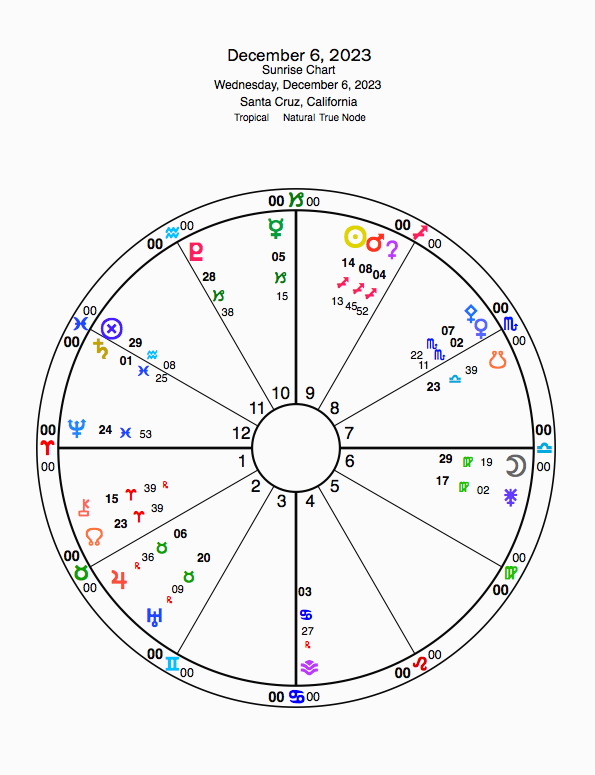
Today, this morning Neptune has stationed direct.
25 degrees Pisces.
The mists & fogs may slowly dissipate wherever Neptune is in everyone’s chart 0 Neptune at 25 degrees Pisces.
With Saturn in Pisces & Neptune in Pisces, Pisces can feel both captured AND in a fog with their fish feet hurting.
In this world period and in a peculiar manner, as far as the race (Aryan) to which the Western world belongs, Neptune is known esoterically as the Initiator.
In certain ancient formulas, the great Teacher of the West and the present world Initiator, Christ, [220] is spoken of as Neptune, Who rules the ocean, whose trident and astrological symbol signifies the Trinity in manifestation and Who is the ruler of the Piscean Age. The formula runs as follows, speaking esoterically: “”The fish goddesses leapt from Earth (Virgo) to the waters (Pisces) give bith to the Fish God (holy child, Christ, the Soul) who introduces the “waters of life” into the ocean of substance & thus brings Light to the world. Thus does Neptune work.”
The above quote (from Esoteric Astrology, p. 220.
This is a great mystery, revealed only at the time of the second initiation (remember from yesterday, Neptune is involved in the 2nd Initiation) in which the control of the fluidic astral plane (emotional nature) is demonstrated.
What is the 2nd Initiation?
Who has the blue books? Who can give a little lesson here?
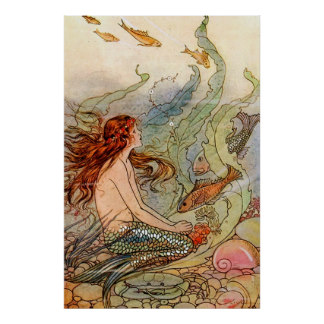
Note: In ancient Lemuria, the symbol of Pisces was a woman with the tail of a fish, and of this symbol the legendary mermaid is the memory. It was only in late Atlantean times (when the conscious sense of duality was becoming present in the minds of the advanced humanity of the period) that the woman part of the symbol was dropped altogether and the two linked fishes took the place of the fish Goddesses.
St. Nicholas Feast Day. December 6, 2019 –
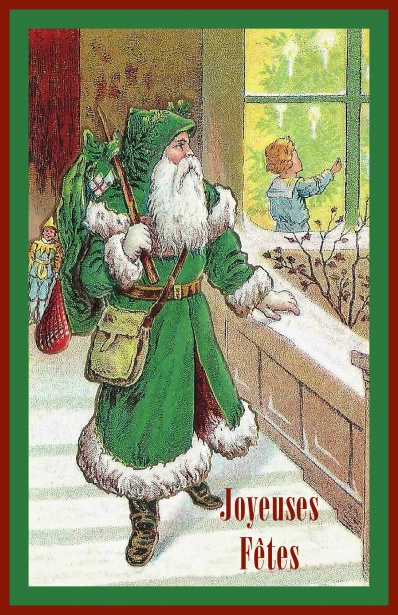
St. Nicholas – wonder worker. Gift giver, Miracle Worker.
Who Was Saint Nicholas?
Saint Nicholas was a Christian bishop who helped those in need. He offered gifts to the poor. After his death, the legend of his gift-giving grew & grew. It touched the hearts of humanity. Over time….as humanity descended more into materialiity, Saint Nicholas transformed into the legendary character called Santa Claus, who brings Christmas presents to children around the world.
Saint Nicholas was born around 280 in Patara, Lycia, an area that is part of present-day Turkey. He lost both of his parents as a young man and understanding suffering, he used his inheritance to help the poor and sick.
A devout Christian, he later served as bishop of Myra, a city that is now called Demre.
There are many legends about Saint Nicholas of Myra. One story tells how he helped three poor sisters. Their father did not have enough money to pay their dowries and thought of selling them into servitude. Three times, Saint Nicholas secretly went to where they lived & at night placed a bag of money inside the home. The man used the money so that one of his daughters could marry. On the third visit, the man saw Saint Nicholas and thanked him for his kindness. St. Nicholas also reportedly saved three men who were falsely imprisoned and sentenced to death.
Over the years, stories of St. Nicholas’s miracles and work for the poor spread to other parts of the world. He became known as the protector of children and sailors and as the gift-giver. He was a popular saint in Europe until the time of the Reformation in the 1500s, a religious movement that led to the creation of Protestantism, which turned away from the practice of honoring saints. Saint Nicholas, however, remained an important figure in Holland.
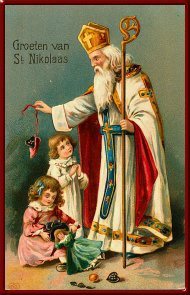
The Dutch continued to celebrate the feast day of Saint Nicholas, December 6. It was a common practice for children to put out their shoes the night before (on Dec. 5, last night). In the morning, they would discover the gifts that Saint Nicholas had left for them. Dutch immigrants brought the legend of Saint Nicholas, known to them as Sint Nikollas or by his nickname, Sinterklaas, to America in the 1700s.
In many areas of Europe towns & villages celebrate St. Nicholas’s day. Children place their shoes or boots outside their doors on the evening of Dec. 5th. The next morning they are overflowing with gifts, candies & sweets. St. Nicholas comes on a horse & often a carrot is left out for St. Nicholas to feed his horse. Sometimes golden coins are left in the shoes. St. Nicholas is “Father Christmas” to many.
France
St. Nicolas comes primarily in Alsace, Lorraine and Nord-Pas-de-Calais (French Flanders). St. Nicolas is patron of Lorraine. A little donkey carries baskets filled with children’s gifts, biscuits (U.S.
‘cookies’) and sweets. The whole family gets ready for the saint’s
arrival on December 6, with grandparents telling stories of the saint
protecting children who are lost. In France, bakeries and home
kitchens are hives of activity as spiced gingerbread biscuits and “mannala” (a brioche shaped like the saint) are baked. At school children learn St. Nicolas songs and poems and draw and paint St. Nicolas pictures and crafts.
Saint Nicolas visits nursery schools, giving children chocolates and
sometimes presents.
Germany
In Germany, Nikolaus is celebrated on a small scale. Many
children put a boot called Nikolaus-Stiefel (Nikolaus boot) outside
the front door on the night of 5 December. St. Nicholas fills the boot
with gifts and sweets overnight, and at the same time checks up on the children to see if they were good, polite and helpful the last year.
If they were not, they will have a tree branch (Rute) in their boots
instead.
Palestine
Saint Nicholas is the patron saint of the town of Beit Jala. This
little town, which is located only two kilometers to the west of
Bethlehem, boasts being the place where St. Nicholas spent four years of his life during his pilgrimage to the Holy Land. Every year on the 19th of December according to the Gregorian Calendar—that is the 6th of December according to the Julian Calendar—a solemn Divine Liturgy is held in the Orthodox Church of St. Nicholas,
followed by parades, fairs, exhibitions, and many activities. Palestinian Christians of all sects, denominations and churches come to Beit Jala and participate in prayers and celebrations.
United States and Canada
While feasts of Saint Nicholas are not observed nationally, cities
with strong German influences like Milwaukee, Cincinnati and St. Louis celebrate St. Nick’s Day on a scale similar to the German custom. As in other countries, there are many people in the United states who celebrate St Nicholas Day by putting their shoes outside their bedroom doors on the evening of 5 December. St Nicholas then comes during the night. On the morning of 6 December, those people will find their shoes filled with gifts and sugary treats. Widespread adoption of the tradition has spread among the German, Polish, Belgian and Dutch
communities throughout the United States.
St. Nicholas & Christmas
On 24 December, Christmas Eve, each child puts one empty stocking/sock on their fireplace. The following morning of 25 December, the children awaken to find that St. Nick has filled their stockings with candy and small gifts. Gifts often include chocolate gold coins to represent the gold St. Nick gave to the poor and small trinkets. They also awake to find presents under the tree, wrapped in Christmas-themed paper. This is a very traditional part of Christmas. After opening gifts, the family attends Mass in the local village, town, community or city. These are traditions many hold today.